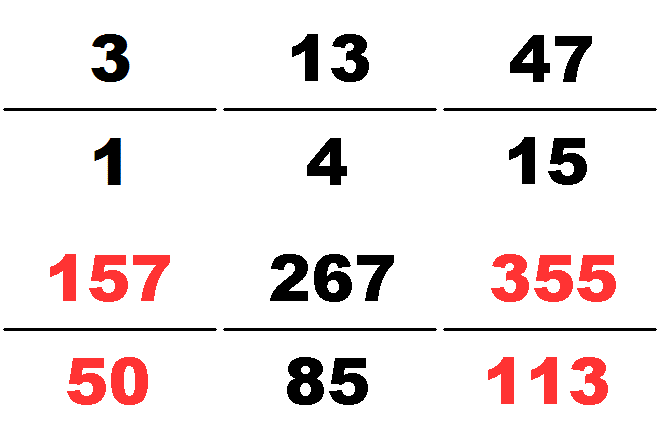
Yet, yesterday I learned a ‘new’ shortcut; that is, I don’t recall that I learned it or used it. I suspect I did though. Both. 😊
As a gift for my granddaughter, I purchased the book Secrets of Mental Math by Arthur Benjamin and Michael Shermer.
The shortcut is explained in the book.
EXAMPLE 1
If we’re asked to calculate  , is there a shortcut?
Yes, my first instinct is to say: 
But is there a better way? There must be a better way!, or read this, if you don’t know Raymond Hettinger.
Reference: https://www.mathpax.com/engineering-math-nov-2023#squares
This works because, from algebra, 
The ‘new’ shortcut is to say 
This works because, from algebra:
![\[\text{Solve }(A-N)\cdot(B+N)\]](https://www.mathpax.com/wp-content/ql-cache/quicklatex.com-32ef0bf6d4955df242b83ce5c6ffca11_l3.png "Rendered by QuickLaTeX.com")
![\[\text{Let }\Delta=A-B\]](https://www.mathpax.com/wp-content/ql-cache/quicklatex.com-075c8e4409e1f2e3320686ae560c0700_l3.png "Rendered by QuickLaTeX.com")
![\[\text{Let }N_{c}=\Delta-N \text{}\]](https://www.mathpax.com/wp-content/ql-cache/quicklatex.com-18ce1bd0f7e9e7f33d5ec8b49d9632ae_l3.png "Rendered by QuickLaTeX.com")
![\[\text{Explanation of notation: I think of }N_{c} \text{ as a complement of }N\]](https://www.mathpax.com/wp-content/ql-cache/quicklatex.com-4ff77ea81c887c132eed8310f2fb1775_l3.png "Rendered by QuickLaTeX.com")
![\[\therefore (A-N)\cdot(B+N) = A \cdot B +(A-B) \cdot N-N^2\]](https://www.mathpax.com/wp-content/ql-cache/quicklatex.com-cd041691738b74ed368a245527081bbe_l3.png "Rendered by QuickLaTeX.com")
![\[\therefore (A-N)\cdot(B+N) = A \cdot B +(A-B-N) \cdot N\]](https://www.mathpax.com/wp-content/ql-cache/quicklatex.com-9a4c3eb26c3b09ddf6334f8f4ddaa8ec_l3.png "Rendered by QuickLaTeX.com")
![\[\therefore (A-N)\cdot(B+N) = A \cdot B +(\Delta-N) \cdot N\]](https://www.mathpax.com/wp-content/ql-cache/quicklatex.com-5f8e9e1a1aca64b3d1a661d1b0b75d1f_l3.png "Rendered by QuickLaTeX.com")
![\[\text{And finally }(A-N)\cdot(B+N) = A \cdot B +N_{c} \cdot N\]](https://www.mathpax.com/wp-content/ql-cache/quicklatex.com-8fcc0d16836f6469e3ac22a675cae146_l3.png "Rendered by QuickLaTeX.com")
![\[\therefore \text{In our example, we have: }\]](https://www.mathpax.com/wp-content/ql-cache/quicklatex.com-caac5b7890889ace9f6bf38166693d9c_l3.png "Rendered by QuickLaTeX.com")
![\[\Delta=70-60=10\]](https://www.mathpax.com/wp-content/ql-cache/quicklatex.com-fddc1049e15c9f963758d3b6c7f5baf8_l3.png "Rendered by QuickLaTeX.com")
![\[N=70-67=3\]](https://www.mathpax.com/wp-content/ql-cache/quicklatex.com-f731edec9ade5abcfa13795d13257c36_l3.png "Rendered by QuickLaTeX.com")
![\[\therefore N_{c}=\Delta-N=10-3=7\]](https://www.mathpax.com/wp-content/ql-cache/quicklatex.com-37ff688746f3b8302d2a16dadad17c3e_l3.png "Rendered by QuickLaTeX.com")
![\[\therefore (A-N) \cdot (B+N) = A \cdot B + N_{c} \cdot N = 70 \cdot 60 + 3 \cdot 7\]](https://www.mathpax.com/wp-content/ql-cache/quicklatex.com-60eaecafd3b16be43878bdc48d0f617d_l3.png "Rendered by QuickLaTeX.com")
But, that’s just a proof and a verbose example.
The problem can be worked in 2 seconds — in our head.
✔EXAMPLE 2
The  value doesn’t have to be 10.
Let’s calculate  .
.
We can say  The answer is: ✔
![\[\text{In this example, we have: }\]](https://www.mathpax.com/wp-content/ql-cache/quicklatex.com-41d0026a23ac7360f61c178993f70501_l3.png "Rendered by QuickLaTeX.com")
![\[\Delta=200-100=100\]](https://www.mathpax.com/wp-content/ql-cache/quicklatex.com-a8b081cb3c742bdb878cd3769bcb03d4_l3.png "Rendered by QuickLaTeX.com")
![\[N=200-198=2\]](https://www.mathpax.com/wp-content/ql-cache/quicklatex.com-2b4a37ca86796ae7e7d0ee003324ef5d_l3.png "Rendered by QuickLaTeX.com")
![\[\therefore N_{c}=\Delta-N=100-2=98\]](https://www.mathpax.com/wp-content/ql-cache/quicklatex.com-ac549fcbc0645997527ca0ed0b119f91_l3.png "Rendered by QuickLaTeX.com")
![\[\therefore (A-N) \cdot (B+N) = A \cdot B + N_{c} \cdot N\]](https://www.mathpax.com/wp-content/ql-cache/quicklatex.com-77af932686c5a7414cc6c834c769d637_l3.png "Rendered by QuickLaTeX.com")
✔EXAMPLE 3
Another example with  .
.
Let’s calculate  .
.
We can say  The answer is: ✔
![\[N=200-185=15\]](https://www.mathpax.com/wp-content/ql-cache/quicklatex.com-f5b7a1df7487ab91b9793bd751c8be20_l3.png "Rendered by QuickLaTeX.com")
![\[\therefore N_{c}=\Delta-N=100-15=85\]](https://www.mathpax.com/wp-content/ql-cache/quicklatex.com-334163b2e441b3e7eecb82eebdc52bef_l3.png "Rendered by QuickLaTeX.com")
✔
This example exhibits some self similarity.
The nested calculation is:  ✔
✔
In summary, I’ve shown two good ways to make a fast mental multiplication. I judge the second method to be more general and faster. The first method involves subtraction of terms, the second involves only addition of terms, therefore easier.
Enjoy!