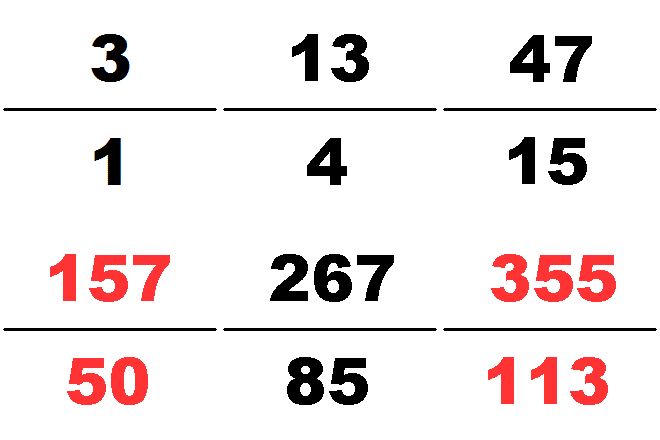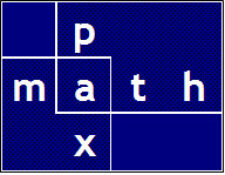
Let’s illustrate with examples from the two groups
Try it by yourself this time
\[(a+b)^2 = a^2+\bold{2}ab+b^2\] \[(a+b)^3 = a^3+\bold{3}a^2b+\bold{3}ab^2+b^3\] \[(a+b)^4 = a^4+\bold{4}a^3b+\bold{6}a^2b^2+\bold{4}ab^3+b^4\]
\[\bold{1}\] \[\bold{1}\ \ \ \bold{1}\] \[\bold{1}\ \ \ \bold{2}\ \ \ \bold{1}\] \[\bold{1}\ \ \ \bold{3}\ \ \ \bold{3}\ \ \ \bold{1}\] \[\bold{1}\ \ \ \bold{4}\ \ \ \bold{6}\ \ \ \bold{4}\ \ \ \bold{1}\] \[\bold{1}\ \ \ \bold{5}\ \ \ \bold{10}\ \ \bold{10}\ \ \ \bold{5}\ \ \ \bold{1}\] \[\bold{1}\ \ \ \bold{6}\ \ \ \bold{15}\ \ \bold{20}\ \ \bold{15}\ \ \ \bold{6}\ \ \ \bold{1}\]
Second, we’ll try a few exponent calculations
$= 1+0.20+0.01 = \bold{1.21}$
$= 1+0.300+0.030+0.001$
$= \bold{1.331}$
Now dropping the last two terms, we have
$\approx 1+0.200000+ (0.015000) … $
$\approx \bold{1.215}$
Therefore, by using only three terms we have an error of less than $0.05%$
Now let’s consider a few squares.
Recall that $(a+b)^2 = a^2+\bold{2}ab+b^2$
Solution: $(70)^2+\bold{2}(70)(3)+(3)^2$
$= 4900+420+9 = \bold{5329}$
Recall that $(a-b)^2 = a^2-\bold{2}ab+b^2$
Solution: $(90)^2-\bold{2}(90)(2)+(2)^2$
$= 8100-360+4$
$= 8100-400+44 = \bold{7744}$
Again $(a-b)^2 = a^2-\bold{2}ab+b^2$
Solution: $(40)^2-\bold{2}(40)(4)+(4)^2$
$= 1600-320+16$
$= 1600-400+96 = \bold{1296}$
Now let’s consider common temperature conversions.
Start with determining the Fahrenheit equivalent of a Centigrade temperature ?
Or $\bold{F} = [1.80] \cdot \bold{C}+32$
Easier if approached using $\bold{F} = [0.90 \cdot 2] \cdot \bold{C}+32$
Which is simply $[2 \cdot \bold{C}]$ less $10%$ plus $32$
Say $700-70$ plus $32$
Say $630$ plus $32$
Therefore, $\bold{662}^\circ\text{F}$
Or $\bold{C} = [0.55\bar5] \cdot [\bold{F}-32]$
Easier if approached using $\bold{C} = [0.50+(0.1) \cdot 0.50+(0.01) \cdot 0.50] \cdot [\bold{F}-32]$
So say $[\bold{F}-32]$ times half plus $[\bold{F}-32]$ times a tenth of a half and so forth
Say half of $318 = 159$
Say $159+15.9 \text{ etc}$
$= 159+16-0.1+1.6+0.16$
$ = 174.9+1.6+0.16 = 176.66$
Therefore, $\bold{176.66}^\circ\text{C}\approx \bold{177}^\circ\text{C}$.
Say half of $319 = 159$ with a remainder of $1$
Say $159+15.9 \text{ etc}$
$= 159+16-0.1+1.6+0.16+[0.6]$
$= 176.66+[0.6]$
Say half of $1618 = 809$
Say $159+15.9 \text{ etc}$
$= 809+80.9+8.1+0.8$
$= 898.8$
Therefore, $\bold{898.8}^\circ\text{C}\approx \bold{899}^\circ\text{C}\approx \bold{900}^\circ\text{C}$.
2, 5
$5 \cdot 2=10$
$2 \cdot 5=10$
To multiply by 5, we can divide by 2 and vice versa, whichever is easier!
2, 50
$50 \cdot 2=100$
$2 \cdot 50=100$
5, 20
$20 \cdot 5=100$
$5 \cdot 20=100$
4
$25 \cdot 4=100$
$4 \cdot 25=100$
To multiply by 25, we can divide by 4 if it’s easier that way
therefore, $\bold{4000}$.
therefore, $\bold{24}$.
8
$12.5 \cdot 8=100$
$8 \cdot 12.5=100$
3
$33.33 \cdot 3=100$
$3 \cdot 33.33=100$
6
$16.67 \cdot 6=16\frac{2}{3} \cdot 6=100$
$6 \cdot 16.67=6 \cdot 16\frac{2}{3}=100$
7
$14.29 \cdot 7=14\frac{2}{7} \cdot 7=100$
$7 \cdot 14.29=7 \cdot 14\frac{2}{7}=100$
9
$11.11 \cdot 9=11\frac{1}{9} \cdot 9=100$
$9 \cdot 11.11=9 \cdot 11\frac{1}{9}=100$
12
$8.33 \cdot 12=8\frac{1}{3} \cdot 12=100$
$12 \cdot 8.33=12 \cdot 8\frac{1}{3}=100$
Could say 47 over 12 less say ~\(\$0.10\);
therefore, ~\(\bold{\$3.90}\).
15
$6.67 \cdot 15=6\frac{2}{3} \cdot 15=100$
$15 \cdot 6.67=15 \cdot 6\frac{2}{3}=100$
$\frac{2}{3} \cdot \frac{3}{2} = 1$
$\frac{2}{3} \cdot 1.5 = 1$