Intro
Structural engineers often refer to uniform loadings but such ideal loadings apply, at best, to dead loads (slabs for example). Actual live loads are unlikely to be uniform. I tabulate maximum moments for several variations in simple beam loading, in each case using a unit total load magnitude but different load geometries.
I found my results slightly surprising.
RESULTS
For the ideal uniform load: 
Settng the total load , we have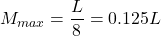
For the single concentrated load: (*)
For the double concentrated load:
(*)
For the double concentrated load: 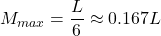 (*)
For the triple concentrated load: (*)
For the quadruple concentrated load:
(*)
For the triple concentrated load: (*)
For the quadruple concentrated load:  (*)
For the quintuple concentrated load: (*)
(*)
For the quintuple concentrated load: (*)
For the N (N is odd) concentrated load: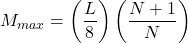 For the N (N is even) concentrated load: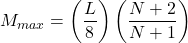
For the sine function load: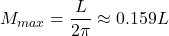 (*)
(*)
For the centered triangular load: (*)
For the right side triangular load: 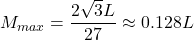 (*)
(*)
Settng the total load
, we have For the single concentrated load:
(*)
For the double concentrated load: (*)
For the triple concentrated load: (*)
For the quadruple concentrated load: (*)
For the quintuple concentrated load: (*)Yes, there’s a pattern.
For the N (N is odd) concentrated load:
For the N (N is even) concentrated load: For the sine function load:
(*)For the centered triangular load:
(*)
For the right side triangular load: (*)Conclusions
All of the loadings marked (*) produce a maximum moment that is larger than that of the unform load of equivalent magnitude.
Calculations