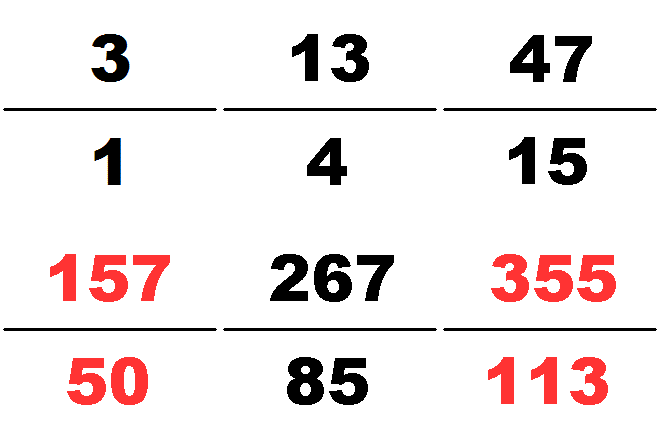
There was a question on Quora
In a box there are 3 cards
"In a box there are 3 cards. One is black on both sides, one is white on both sides, and one is black on one side and white on the other side. I draw one card randomly and one side of it is black. What is the probability that the other side is also black?"
Unfortunately when I saw this question, I also saw the posted answer. I admit I would have gotten it wrong.
(*) Solution Link: I say John Portwood’s answer is the best.
I decided to send the question to the kids and grandkids. Yep, I’m that guy.
Though we all expect there’s a trick, we can’t quite see the trick before we answer.
From here on, the solution is discussed, therefore, spoiler alert.
Why calculate the answer?
I did understand, and I did appreciate, the mathematical explanation for the problem solution but, I thought why not try the physical experiment.
- I made 1.5” square cards and put them in a (relatively) large box. I tried a short sequence of 12. This is true to the problem setup but a bit slow and clumsy in practice.
As I made the cards, I noted the symmetry of the setup, and therefore, the symmetry of the solution. I realized that when I picked a card, it wouldn’t matter what color it was; the pick could be used as-is, because of the symmetry. To be clear, I didn’t need 12 black picks.
The (exceptionally lucky) results: 8 times the other side was black; 4 times the other side was white.

This, of course, matched the arithmetical answer. - Then I tried Scrabble tiles. I imagined 3 Scrabble tiles in a bag would be easier/better for a longer test sequence. Easier than using cards, this method was quick.
Refer to the solution link above for the numbering scheme (*).
• B (for B1/B2)
• W (for W1/W2)
• N (for B3/W3)
This time I did a sequence of 24.
The results: 14 times the other side was black; 10 times the other side was white.

- Finally I tried a 6-sided (conventional cube) die.
• 1 = B1
• 2 = B2
• 3 = B3
• 4 = W1
• 5 = W2
• 6 = W3
~~~
It occurred to me that the die table above illustrates the answer (!) — no need to run the experiment.
1, 2, 4, 5 are sides on the same‑color‑cards and
3 and 6 are sides on the opposite‑color‑card
∴ 2 out of 3
This time I did a sequence of 24 throws of 3 dice each. very easy and fast.
The results: 46 times the other side was black; 26 times the other side was white.

Summary
Let



The insight needed in this problem, is recognizing that the black/black card has two distinct black sides.
This insight affects both the and the
  .
.
The insight needed in this problem, is recognizing that the black/black card has two distinct black sides.
This insight affects both the
and the .- The mathematics approach works
- The physical experiment works
- The physical experiment seems to verify the math
- The physical experiments revealed the symmetry
- The altered physical experiment (using dice) worked
- The altered physical experiment was most satisfying as it revealed the mathematical answer
Related Posts