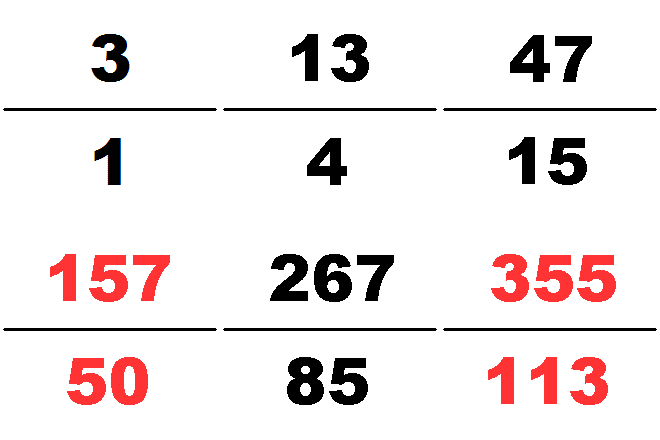
Suitable as bookmarks. (this post was updated on 3/30/2026)

Note
This method, as shown, is applicable and very easy for dates in the 1900s and the 2000s. All easily memorized.
I say, of all the algorithms for the Day of the Week (DOW), this is the easiest for mentally working dates in the interval 1900 to 2050.
Nakai’s formula might be easiest for programming the DOW.
If a date is early in the 1900s, or late in the 2000s then an alternate starting point can be used. The following can be substituted for 2052:
| 2052 – (5 x 28) | 1912 |
| 2052 – (4 x 28) | 1940 |
| 2052 – (3 x 28) | 1968 |
| 2052 – (2 x 28) | 1996 |
| 2052 – (1 x 28) | 2024 |
| 2052 + (1 x 28) | 2080 |
| 2052 + (2 x 28) | 2108 |
| 2052 + (3 x 28) | 2136 |
If a date is in the 1800s, then an alternate starting point can be used and the day of the week must be incremented by 1. The following can be substituted for 2052:
| 2052 – (6 x 28) | 1884 |
If a date is in the 1700s, then an alternate starting point can be used and the day of the week must be incremented by 2. The following can be substituted for 2052:
| 2052 – (9 x 28) | 1800 |
Citation
The general method illustrated, known as the Doomsday rule, was conceived and popularized by John Horton Conway (of Game of Life fame).
Unfortunately, I cannot remember where I found this specific method (using 2052 as a basis). If anyone knows the source of this specific method, please let me know. Thanks.
Excellent Articles
Tomorrow is the Day after Doomsday (excerpt from PDF of the original Eureka publication)
from the Eureka Digital Archives
Tomorrow is the Day after Doomsday is Conway’s first ever publication on his Doomsday method. In his article he outlines what I think is the very simplest approach to determining the Doomsday for a given year within the last 300 years.
If we just remember:
1700 => 0
1800 => 5
1900 => 3
2000 => 2
1800 => 5
1900 => 3
2000 => 2
~~~